Today we’ll have a look at another chip that has absolutely earned its place in the history of electronics. Designed in 1986, the MAX232 represented a small revolution in IC design and put Maxim, then still an upstart, in the spotlight for the first time. Dave Bingham was the driving force behind the MAX232’s design, in a team led by Dave Fullagar (of UA741 fame).
The MAX232 became popular because it was very easy to use and it solved a common problem: many computer systems running on a single +5V supply used RS-232 standard serial interfaces, which required +/- 15 V signal levels. The MAX232 was a transmitter/receiver chip with a built-in charge pump that generated the required signal voltages directly from a +5 V supply, removing the need for two additional supply rails.
Clever marketing also made the MAX232 a huge success for Maxim. Putting a big “MAX” in front of its part number made it immediately clear who made the chip, unlike TI’s “SN” or National’s “LM”. The fact that the ‘232 became the most popular among Maxim’s MAX2xx series (which ran at least from MAX220 to MAX249 back in the day) could be either because that number matched its RS-232 functionality, or simply because it had the most commonly used combination of channels (two transmitters and two receivers).
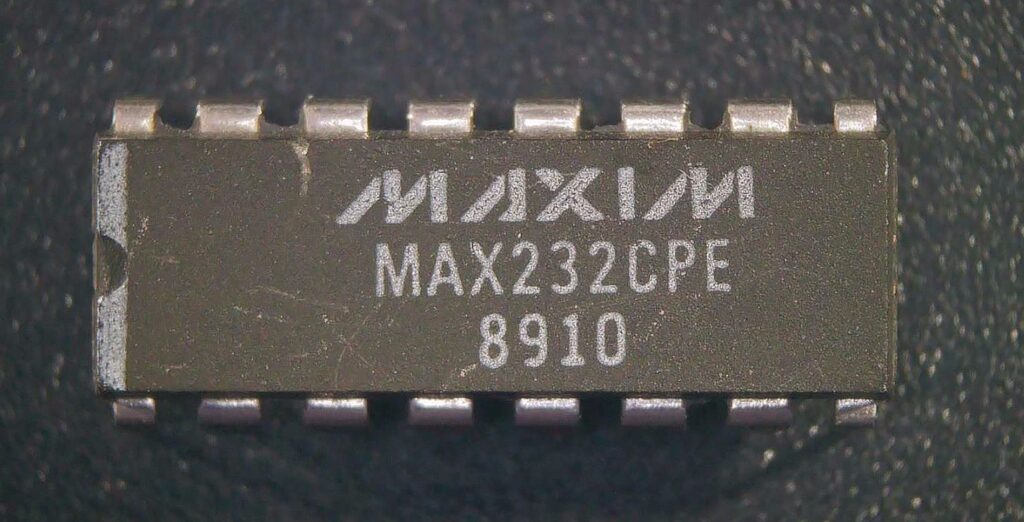
Maxim has since expanded its RS-232 transceiver range to include dozens of different models with varying numbers of channels, different supply voltage ranges (like the 3V MAX3232), power-down options (MAX242), and even integrated capacitors (MAX233) and isolation transformers (MAX252). But the classic MAX232 seems to remain its most popular model. I dug around in my parts bin and found this MAX232CPE from 1989. It’s housed in a 16-pin plastic DIP package.
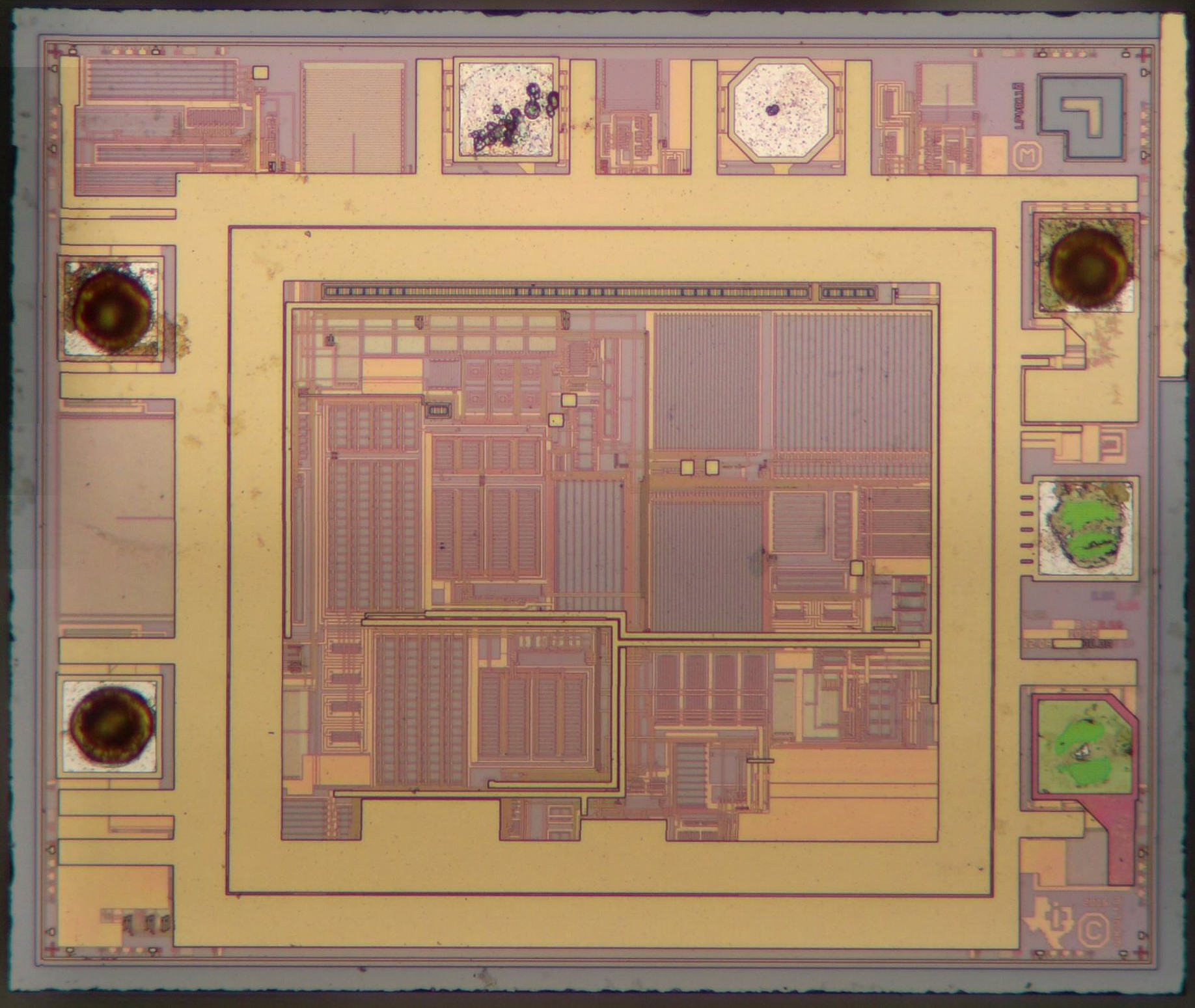
If we open it up, we find the chip shown below. Maxim’s original datasheet includes an (extremely grainy) chip photo that matches what we see here. We’ve got the charge pump on the left, the receivers and transmitters on the right, and control circuits in the middle. This chip was fabricated in Maxim’s 3 micron CMOS process (called S3 or SG3).
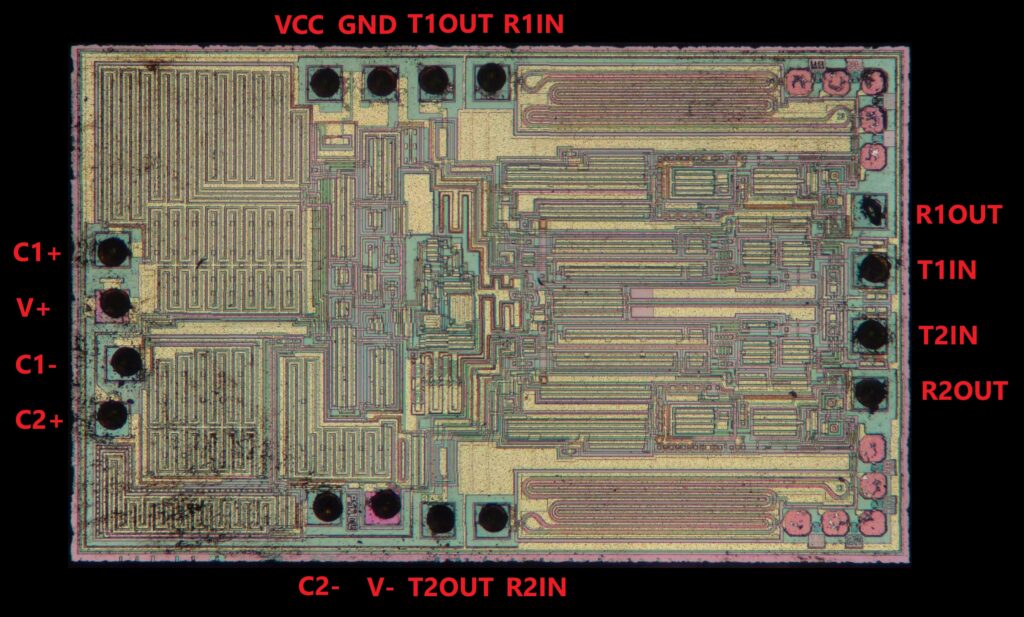
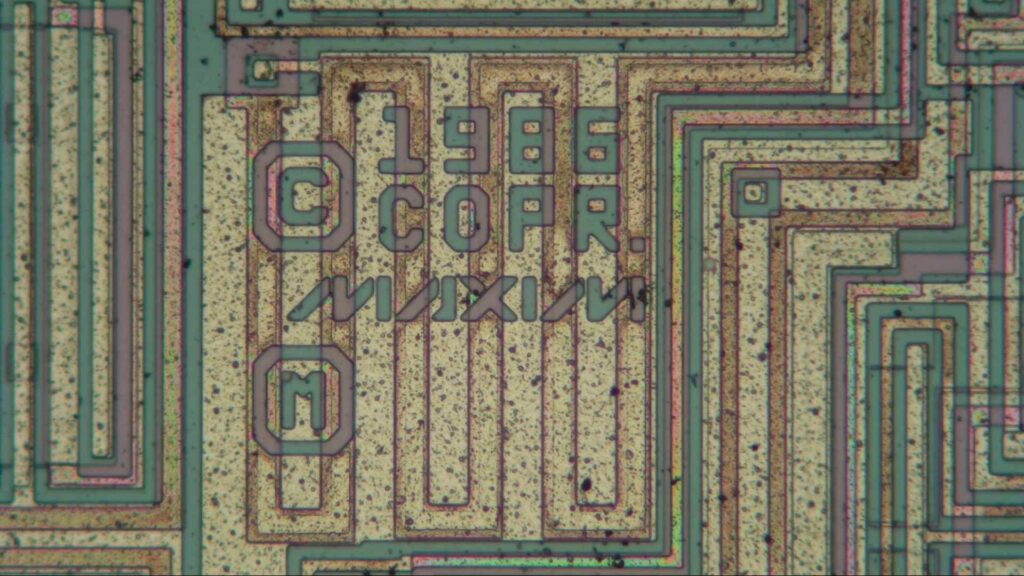
A small 1986 copyright message in the middle confirms we’re looking at the very first generation of this chip.